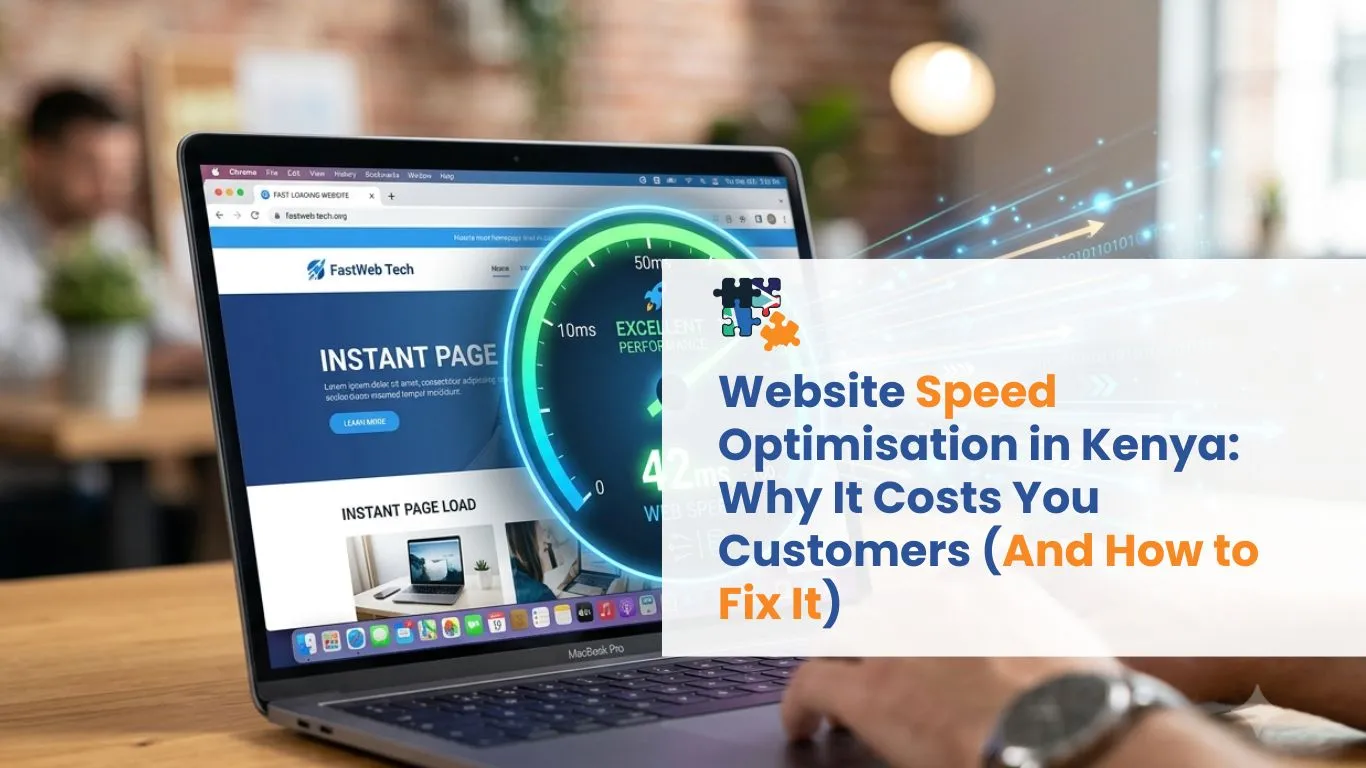
You have a website. You paid for it, you launched it but customers are not converting. Before you blame the design or the copy, check one thing first: how fast does it load? For businesses operating in Kenya, website speed optimisation is one of the highest-impact improvements you can make and it is still one of the most overlooked.
This guide breaks down why slow websites cost Kenyan businesses money, what Google looks at when measuring speed, and the practical steps to fix it.
Why Website Speed Matters More in Kenya Than You Think
Kenya has one of the highest mobile internet penetration rates in Africa. Most of your visitors are on a smartphone possibly on a 4G or even 3G connection. When your website takes more than three seconds to load, a large portion of those visitors will leave before they see a single word of your content.
The data is consistent across markets: a one-second delay in page load time can reduce conversions by up to 7%. For a Kenyan e-commerce store generating KES 500,000 a month, that is KES 35,000 in lost revenue from one second. The faster your site, the more of that traffic turns into leads, bookings, or sales.
Google also uses speed as a ranking signal. A slow website does not just frustrate visitors it pushes you down in search results, meaning fewer people find you in the first place.
What Google Measures: Core Web Vitals Explained
Since 2021, Google has used a set of metrics called Core Web Vitals to evaluate page experience. These are the three you need to know:
1. Largest Contentful Paint (LCP)
LCP measures how long it takes for the main content on a page typically a large image or heading to appear. Google wants this under 2.5 seconds. Most Kenyan business websites we audit come in above 4 seconds on mobile.
2. Interaction to Next Paint (INP)
INP measures how quickly your site responds when someone taps a button or link. Anything above 200 milliseconds feels sluggish. Heavy JavaScript and unoptimised plugins are common culprits on WordPress sites built in Kenya.
3. Cumulative Layout Shift (CLS)
CLS measures visual stability whether elements jump around while the page is loading. A high CLS score means users accidentally tap the wrong button because a banner loaded and pushed everything down. This is especially frustrating on mobile.
You can check your website’s scores right now using Google PageSpeed Insights. Run it on your homepage and your most important landing page. Focus on the Mobile score — that is what most of your Kenyan visitors will experience.
The Most Common Speed Problems on Kenyan Business Websites
In our experience building and auditing websites across Nairobi and the wider Kenyan market, the same issues appear again and again:
- Unoptimised images. A single PNG uploaded directly from a camera can be 5–10 MB. Multiply that by ten images on a homepage and you have a page that will never load quickly on mobile data.
- Too many plugins. WordPress sites are often bloated with 20–30 active plugins, each loading its own scripts and styles. Most are unnecessary or have better alternatives built into a quality theme.
- No caching. Without a caching plugin, your server rebuilds every page from scratch on every visit. Caching stores a ready-made version so repeat visitors load instantly.
- Unminified CSS and JavaScript. Code files often contain spaces, comments, and formatting that are useful for developers but add unnecessary weight for browsers loading your site.
- No CDN. If your website is hosted on a server in Europe or the US, every Kenyan visitor’s request has to travel halfway around the world before anything loads. A Content Delivery Network brings your files closer to your audience.
- Cheap hosting. Shared hosting with overloaded servers is one of the most common causes of slow Time to First Byte (TTFB) — the time before your server even starts sending content.
How to Improve Your Website’s Speed: Practical Steps
You do not need to rebuild your website to fix most speed issues. Here is where to start:
Compress and convert your images
Convert all images to WebP format. WebP files are typically 25–35% smaller than JPEG or PNG at the same visual quality. If your website is on WordPress, a plugin like ShortPixel or Imagify will handle this automatically.
Install a caching plugin
WP Rocket is the most effective paid option. WP Super Cache is a solid free alternative. Either will dramatically reduce load times for returning visitors and is one of the fastest single improvements you can make.
Use lazy loading
Lazy loading means images below the fold only load when a user scrolls to them, rather than all at once when the page opens. WordPress 5.5 and above enables this by default, but verify it is active on your theme.
Minify CSS and JavaScript
Most caching plugins include a minification option. Enable it and test your site thoroughly occasionally minification can conflict with a plugin or theme, which is easy to identify and fix.
Upgrade your hosting or add a CDN
If your PageSpeed score shows a high Time to First Byte, the problem is at the server level. Moving to a VPS or managed WordPress hosting (Kinsta, WP Engine, or a local provider with SSD storage) will make an immediate difference. Cloudflare’s free tier also works as a CDN and significantly improves load times for users in East Africa.
What a Fast Website Does for Your Business in Kenya
Beyond SEO rankings, a fast website directly affects your bottom line:
- Higher conversion rates — more visitors complete enquiry forms, calls-to-action, or purchases
- Lower bounce rates — people who arrive on a fast page are more likely to explore other pages
- Better ad performance — Google Ads and Meta Ads both factor in landing page speed when determining ad quality scores, affecting your cost per click
- Stronger brand trust — a slow website signals an unprofessional operation to a first-time visitor
When we rebuilt the website for one of our clients in Nairobi, cutting their LCP from 6.2 seconds to 1.8 seconds resulted in a 40% increase in enquiry form submissions within the first month — with no other changes to the page.
Not Sure Where to Start? We Can Audit Your Site
ChochaByte provides full website performance audits for businesses across Nairobi and Kenya. We identify exactly what is slowing your site down, prioritise the fixes by impact, and implement them — so you can focus on running your business.
We have done this for businesses in fintech, healthcare, retail, and professional services. If your web design in Kenya is not performing the way you expected, speed is often the first place to look.
You can also explore our recent guide on how to choose the best web design company in Nairobi and what every business needs to know before building a website for more context on what separates high-performing websites from the rest.
Ready to stop losing customers to a slow website? Get in touch with ChochaByte and we will run a free performance check on your homepage.